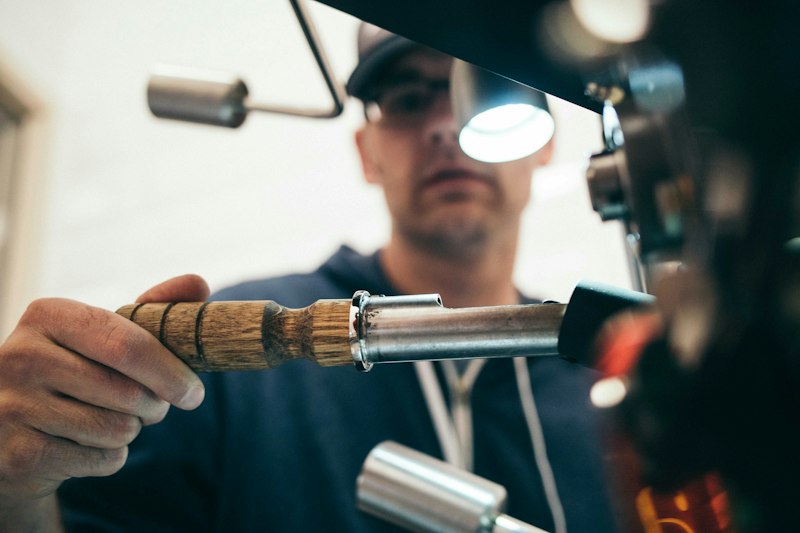
Miriam Voss's Berlin studio smells like coffee and electronics. Against one wall, three large monitors display a cascade of numbers — her generative system mid-process, producing outputs she may never mint. Against another, a shelf of geology textbooks and a worn sketchbook. "The algorithm and the hand," she says. "I need both."
Voss, 34, has been making generative art for nearly a decade, but the last eighteen months have been transformative. Her series Sediment — 100 works exploring the visual language of geological strata — sold out within hours of release, and the secondary market has been relentless ever since. The top sale, Sediment III, reached 9.8 ETH in January, a platform record for her work.
We spoke for three hours about algorithms, emotional labor, the strange experience of watching your art develop a life of its own, and why she recently turned down a seven-figure commercial offer.
On the Origin of Sediment
The Collector: Sediment has this very specific visual vocabulary — layered, sedimentary, geological. Where did that come from?
Miriam Voss: I had a period of about six months where I was going through something personal — I don't want to be too specific — and I found myself obsessed with the idea of compression. How time compresses things. How pressure creates structure. Geology felt right because it's about deep time. Not human time. Not the time of a news cycle or a market cycle. Real time.
I started reading about stratigraphy — how geologists read rock formations. There's a kind of reading that happens, a kind of narrative interpretation, but based entirely on physical evidence. I thought: can I build a generative system that works the same way? That produces visual evidence of processes that the viewer has to interpret?
TC: Did you have a sense early on that the series would resonate the way it did?
MV: No. Honestly, I thought it might be too slow. Too quiet. I'd seen what was performing well on the market at the time, and it was often more immediately spectacular. Sediment is patient. You have to sit with it. I wasn't sure people had the patience.
"I built a system that knows how to grieve — not metaphorically. The parameters that govern color temperature are calibrated to emotional states I documented over six months. The algorithm doesn't know that. But it shows."
They did. The release day was genuinely surreal. I was watching the mint from my phone in the studio, and within forty minutes everything was gone. And then the secondary market started moving almost immediately. I had to close my laptop and go for a walk. It was too much information.
On the Algorithm's Emotional Interior
TC: There's something in Sediment that feels emotionally weighted — not just visually interesting. People describe the works as melancholy, or contemplative. Is that intentional?
MV: Yes and no. I didn't sit down and say "I will make a sad algorithm." But I built it during a difficult period, and the choices I made — about color temperature, about the rate of change in the layers, about what the system treats as a perturbation versus a gradual transition — those choices are emotionally inflected. I can't separate them from the state I was in.
I've thought about this a lot. The algorithm doesn't have feelings. But it was designed by someone who does, and who was feeling quite specifically. So in some sense, yes — the algorithm has an emotional interior. It's mine, encoded into the parameters.
"The most interesting question isn't whether the machine can feel. It's whether a machine can accurately transmit a feeling its designer had while building it. I think Sediment answers that: yes, it can."
Miriam Voss, Studio Interview, February 2026
On Collecting and Collectors
TC: You interact with your collectors quite actively. Is that a deliberate choice?
MV: It's not strategic — it's genuine. I'm curious about what people see in the work. Not because I need validation. But because the work gets completed by the viewer, in a way. And I want to understand what completions are happening.
Some of the most interesting conversations I've had about Sediment have been with collectors who came to it with no knowledge of my intentions — no artist statement, no interviews — and arrived at interpretations that were structurally similar to what I was thinking about but arrived there from completely different places. That fascinates me. It suggests the work is doing something that I can't fully control or explain.
TC: You turned down a major commercial offer recently. Can you talk about that?
MV: I'd rather not name the company. But yes. The offer involved using the Sediment aesthetic — the visual language of the series — in a commercial context. A very high-profile one. The money was significant.
I said no because the work isn't mine to commercialize that way. Some of those works are in people's collections. They trusted that what they were buying had a certain kind of cultural integrity. If I license the aesthetic for advertising, I've changed what they own — retroactively. That's not something I'm willing to do.
On What Comes Next
TC: Sediment is clearly the work you're known for now. Is that a constraint?
MV: It would be if I let it. I'm already working on something very different — much faster, much more chaotic. I want to make something that feels like the opposite of Sediment. High-frequency, almost anxious. I've been thinking about weather systems instead of geological ones. Turbulence instead of compression.
I don't know if it will sell as well. I hope people will trust me enough to come with me somewhere new. That's the relationship I want with the people who collect my work — not a transaction, but a sustained conversation. We're in this together, wherever it goes.
Interview
Generative Art
Artist Profile
Berlin
Sediment